Hiring Freelancers vs. a UI/UX Design Agency: What to Expect for Timeline, Quality, and Budget

Freelancer or agency? Compare real timelines, quality standards, and budgets for UI/UX design so you can staff your next product build with confidence.
Your product roadmap won't wait for a designer to "find time between other clients." If you've ever watched a freelance UI/UX hire go dark for two weeks mid-sprint, you already know the real cost isn't the hourly rate — it's the momentum you lose. Hiring freelancers vs. a UI/UX design agency is really a question about risk tolerance: how much timeline slippage, quality inconsistency, and project management overhead can your business actually absorb?
This guide breaks down what to realistically expect from each path — in weeks, in dollars, and in the quality of what ships.
TL;DR — The Fast Answer
Freelancers are cheaper hourly but carry higher risk of delays, scope gaps, and single-point-of-failure dependency.
Agencies cost more upfront but bundle research, UI, UX writing, and dev handoff into one accountable, predictable process.
Timeline: Freelancers can be faster for small, isolated tasks; agencies are faster for full product builds because work runs in parallel.
Quality: Agencies enforce design systems and QA review; freelancer quality varies wildly by individual.
Budget: The cheapest quote rarely stays cheapest once rework, delays, and management time are factored in.
Best fit: Freelancers for narrow, well-defined tasks. Agencies for anything tied to revenue, funding, or brand-critical launches.
Freelancers vs. a UI/UX Design Agency: The Core Structural Difference
The decision isn't really "person vs. company." It's one generalist vs. a coordinated team of specialists.
A freelancer is typically one person handling research, wireframes, visual design, and sometimes prototyping. A design agency splits that same workload across a UX researcher, UI designer, content strategist, and project manager working simultaneously.
That structural difference is what drives almost every downstream outcome in this comparison — timeline, quality, and budget all trace back to it.

Timeline: How Fast Can You Actually Launch?
Freelancers can look faster on paper. A single designer quoting "2 weeks for a landing page" sounds efficient — until that same designer has three other clients competing for their calendar.
Agencies quote based on team capacity, not individual availability, which is why their timelines tend to hold up under pressure. A dedicated pod can run user research and UI exploration in parallel instead of waiting on one person to finish each phase before starting the next.
For a full product design engagement — say, a SaaS dashboard redesign — a freelancer might realistically take 8 to 14 weeks, largely due to context-switching between clients. An agency team can often compress that to 4 to 8 weeks because specialists work concurrently.
The exception: for a single, well-scoped deliverable (one landing page, one icon set), a responsive freelancer can genuinely outpace an agency's onboarding process.
Quality: What "Good Design" Really Costs to Deliver
Quality inconsistency is the most common complaint founders raise about freelance hires. It's not usually about talent — it's about process discipline.
A skilled freelancer can produce excellent individual screens. But without a second set of eyes — a QA pass, a design critique, an accessibility review — errors and inconsistencies slip through more easily.
Agencies build these checkpoints into the process by default: peer review, design system enforcement, and cross-functional QA before anything reaches the client. That's not a knock on freelance talent; it's simply what a team structure allows that a solo practitioner cannot replicate alone.
If you want a candid read on how your current interface holds up, [Request a Free UI/UX Audit -> /services/ui-ux-audit] and our team will flag usability gaps before they cost you conversions.
Budget: Comparing the True Cost, Not Just the Invoice
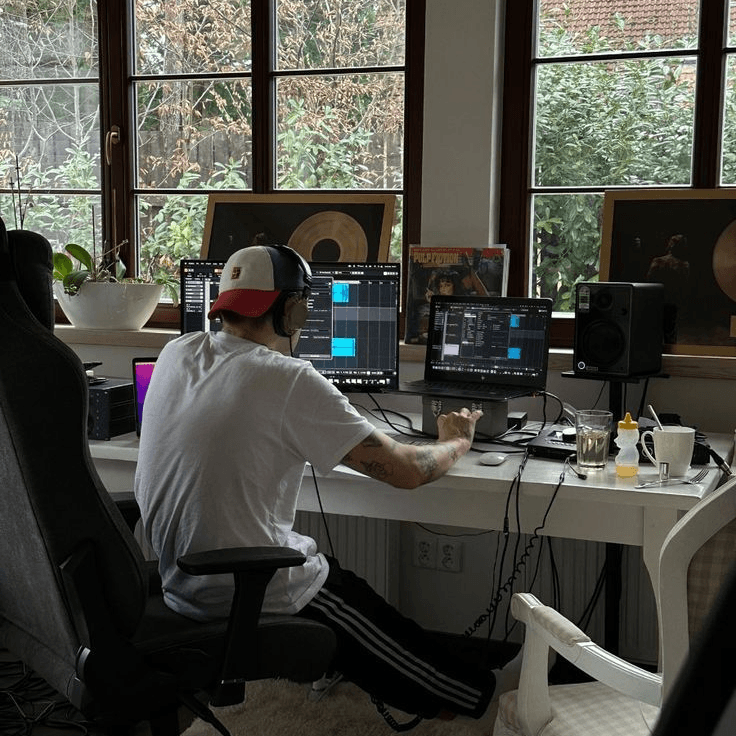
On the surface, freelancers almost always win on hourly rate. A freelance UI/UX designer might charge $50–$150/hour, while an agency's blended team rate often lands at $100–$250/hour.
But the invoice is only part of the real cost. The true cost includes rework, missed deadlines, and the hours you personally spend managing the project.
According to [industry benchmarking on agency pricing models -> Industry Data Source], blended team rates reflect built-in project management, QA, and revision cycles that freelancers typically bill as separate, additional line items.
When you add up freelancer rework cycles, delayed launches, and your own time spent chasing status updates, the effective cost per shipped, production-ready screen frequently ends up comparable — or even higher — than an agency engagement.
The Hidden Costs Nobody Puts in the Proposal
Three costs rarely show up in a freelancer quote but show up in your actual budget every time.
Project management time. Someone has to write specs, chase revisions, and keep the freelancer aligned with engineering — and that someone is usually you or your product manager.
Tooling and handoff friction. Freelancers often work in their own file structures, which can create messy handoff to your dev team without a shared design system.
Continuity risk. If a freelancer gets sick, takes another client, or simply disappears mid-project, you have no backup — the entire engagement stalls.
Agencies absorb all three by design: a project manager owns coordination, a shared design system governs handoff, and team redundancy means no single point of failure.
Curious what that looks like in practice? Our [SaaS Dashboard Redesign Case Study -> /work/saas-dashboard-redesign] shows the full process from research to dev-ready handoff in six weeks flat.

When a Freelancer Is Genuinely the Right Call
Freelancers are the smarter choice in a few clear situations. Don't over-engineer a simple problem.
You need one isolated deliverable, like a single marketing page or icon set.
You already have an in-house design system and just need extra hands to execute against it.
Your timeline is flexible and budget is the primary constraint.
The project has low complexity and low risk if something slips by a few days.
If your need fits squarely in this list, a strong freelancer sourced through a trusted network can be the faster, cheaper path.
When an Agency Is Clearly the Better Investment
The calculus flips once the stakes or scope grow. Complexity and consequence are what justify the higher rate.
You're designing a full product, not a single page or asset.
The work is tied to a fundraise, launch, or revenue milestone where delays are expensive.
You need research, UX writing, UI, and dev handoff to all stay in sync.
You don't have in-house bandwidth to manage a freelancer's day-to-day output.
According to [research on product design's impact on business outcomes -> Industry Data Source], well-designed digital products consistently outperform competitors on user retention and revenue growth — which is precisely the kind of outcome that justifies investing in a coordinated team over a single contractor.
How to Make the Right Call for Your Product
Start by asking one honest question: is this a task, or is this a system?
A task — a single screen, a one-off asset — is freelancer territory. A system — an entire product experience that needs to scale, stay consistent, and survive a founder's shifting priorities — needs a team built to hold that complexity.
If you're still unsure which category your project falls into, walk through our [Product Design Process -> /services/product-design] page, or book a scoping call and we'll tell you honestly which path fits — even if that means pointing you toward a freelancer instead of us.
The Bottom Line
There's no universally "right" answer between freelancers and a UI/UX design agency — only the right answer for your project's complexity, timeline pressure, and risk tolerance. Match the structure of your hire to the structure of your problem.
If your product is heading into a critical launch window and you can't afford a stalled timeline or inconsistent UI, it's worth talking to a team built to prevent both. [See Our Full Portfolio -> /work] to see how that process plays out across real client launches, or reach out directly to scope your project with our team.