In-House Design Team vs. Full-Service Creative Agency: A Cost and Speed Comparison for Startups

In-House Design Team vs. Full-Service Creative Agency: A Cost and Speed Comparison for Startups
You need a landing page shipped, a product redesigned, or a pitch deck that doesn't embarrass you in front of investors — and you need it done yesterday. The decision between building an in-house design team vs. full-service creative agency usually gets made under pressure, with a spreadsheet half-finished and a launch date already public.
That's the wrong way to make a six-figure decision. This guide breaks down the actual costs, realistic timelines, and hidden trade-offs of each path, so you can choose based on math instead of momentum.
TL;DR: The Fast Answer
In-house teams cost more upfront (salaries, benefits, tools) but pay off if you need design output every single week for 18+ months.
Full-service agencies get you senior-level talent in days, not months, with no severance risk or recruiting overhead.
Speed favors agencies almost universally — most studios can start within 1-2 weeks versus 6-10 weeks to hire one in-house designer.
Cost crosses over around month 14-18 for most early-stage startups, after which in-house can become cheaper — if retention holds.
The right choice depends on your design workload volatility, not just your budget.
Why This Decision Feels So High-Stakes Right Now
Founders rarely think about design infrastructure until they're blocked by it. A fundraise deck is due, a competitor just shipped a slicker product, or an early hire quietly admits they "can't do it all anymore."
At that point, the in-house design team vs. full-service creative agency question stops being theoretical. It becomes a race between two very different clocks: how fast you can hire versus how fast you can onboard outside help.
If your product roadmap changes every sprint, that volatility itself is a cost driver — and it's one most cost comparisons ignore entirely.

The Real Cost of Building an In-House Design Team
The advertised salary is never the real number. A mid-level product designer in a competitive market typically commands $85,000-$130,000 base salary, before you add anything else.
Layer on payroll tax, healthcare, equity dilution, and software licenses (Figma, Adobe Creative Cloud, prototyping tools), and you're realistically looking at 1.25-1.4x the base salary in total loaded cost. For a single senior designer, that's often $140,000+ per year fully loaded.
And one designer rarely covers everything a startup needs. Most teams eventually require some split of product UI, brand identity, marketing assets, and motion or web design — skill sets that rarely live in one person.
That's the part budgets miss: you're not hiring a designer, you're building a discipline. According to [industry compensation data -> Link to Industry Data Source], design salaries have climbed steadily faster than general tech hiring over the past three years, making this cost harder to predict than it used to be.
The Hiring Timeline Tax
Beyond salary, there's a slower, less visible cost: time. Sourcing, interviewing, and closing a strong design hire typically takes 6 to 10 weeks in a competitive market, and that's before their notice period at a previous job.
During that entire window, your design backlog doesn't pause. It grows.
What a Full-Service Creative Agency Actually Costs
Agency pricing generally falls into two models: monthly retainers (typically $4,000-$15,000/month depending on scope) or fixed project fees for defined deliverables like a rebrand or product redesign.
The headline number often looks higher than a single salary. But a retainer buys you an entire bench — strategists, UI/UX designers, brand specialists, sometimes developers — without separate recruiting, onboarding, or benefits costs for each one.
You're effectively renting a full creative department for the price of one senior hire. For startups with unpredictable workload (a launch this month, nothing next month), that flexibility is often worth more than the raw hourly rate suggests.
If you're unsure whether your current product experience justifies the investment either way, it's worth starting with a clear-eyed look at where the gaps actually are — [request a free UI audit of your product -> Link to Portfolio/Service Page] before committing budget in either direction.
Speed to Launch: In-House vs. Agency Timelines
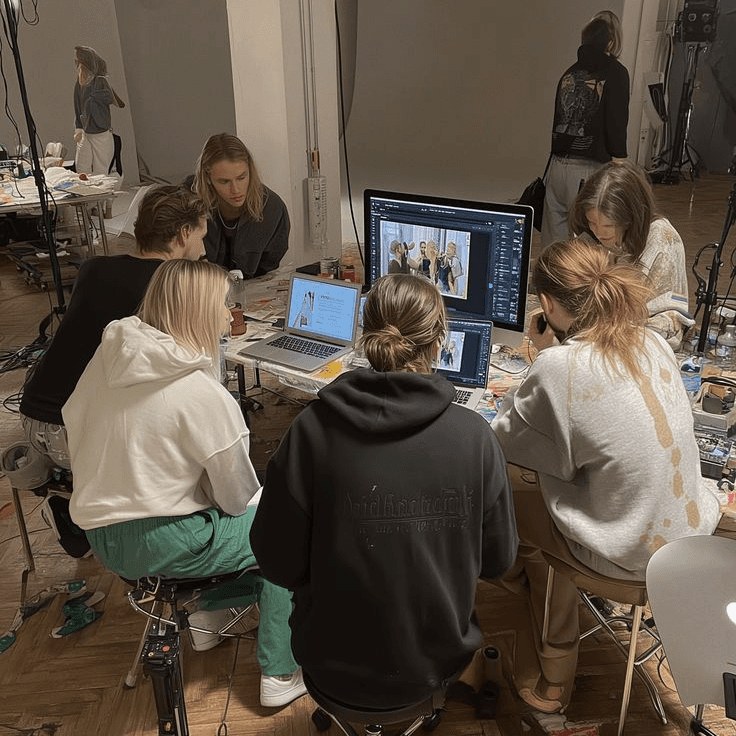
Speed is where the in-house design team vs. full-service creative agency comparison gets clearest. If you need design output in the next two weeks, hiring is almost never the answer.
A full-service agency with existing systems, templates, and senior staff can typically start discovery within days and deliver first drafts inside two to three weeks. An in-house hire, by contrast, needs weeks just to reach their first day of work.
Even after onboarding, a new in-house hire needs 4-8 weeks to reach full productivity on your specific product and brand voice. An established agency has already built that muscle across dozens of other clients.
This is exactly the gap we closed for a recent early-stage client — see how we took their product from concept to polished interface in under three weeks in [our SaaS dashboard redesign case study -> Link to Portfolio/Service Page].
Hidden Costs Nobody Talks About
The sticker price of either option is rarely the full story. Three hidden costs quietly change the math for most startups.
Turnover risk is the biggest one for in-house teams. Losing a sole designer means losing institutional knowledge overnight, plus another 6-10 week hiring cycle while your roadmap stalls.
Management overhead is the second. Someone — usually a founder or product lead — has to manage, mentor, and review a design hire's output, which is time pulled directly from other priorities.
Tool sprawl is the third, smaller but real cost. Each additional in-house creative hire often means new software licenses, file organization systems, and design-ops processes that agencies already have solved.

According to [workforce turnover research -> Link to Industry Data Source], creative and design roles see above-average turnover in early-stage companies, largely due to limited mentorship and unclear growth paths — a risk that's structurally built into solo in-house hires.
When In-House Actually Makes Sense
In-house isn't the wrong answer — it's the right answer under specific conditions. If your company has 18+ months of committed runway and a steady, predictable design workload every single week, the math starts favoring a full-time hire.
It also makes sense once you're large enough to need 2-3 designers minimum, since that scale starts to justify dedicated management and infrastructure. Companies at Series B and beyond, with mature products and consistent iteration cycles, are the clearest fit.
The tell is consistency, not size. If design demand is steady and predictable rather than bursty, in-house economics improve significantly.
When a Full-Service Creative Agency Makes Sense
A full-service agency is the stronger fit for most pre-seed through Series A startups, where design needs are real but uneven — heavy before a launch, lighter in between. It's also the better call when you need multiple disciplines at once: brand, product UI, and marketing, without hiring three separate specialists.
If you're heading into a fundraise, a rebrand, or a major product launch and need senior-level output fast, an agency's existing systems and bench depth are hard to replicate with a single new hire. You get instant access to a team that's already solved your exact problem for other clients.
Curious what that looks like in practice? Browse [our full-service brand and product design portfolio -> Link to Portfolio/Service Page] to see the range a single engagement can cover.
Side-by-Side: Cost and Speed at a Glance
Factor | In-House Design Team | Full-Service Creative Agency |
|---|---|---|
Time to first deliverable | 6-10 weeks (hiring) + 4-8 weeks (ramp-up) | 1-2 weeks (kickoff) + 2-3 weeks (first drafts) |
Typical annual cost | $140,000+ fully loaded, per senior hire | $48,000-$180,000/year (retainer-dependent) |
Skill breadth | Limited to hire's specialty | Full bench: brand, UI/UX, motion, strategy |
Turnover risk | High impact if one person leaves | None — team continuity built in |
Best fit | Steady, high-volume design workload | Variable workload, fast timelines, multi-discipline needs |
This is exactly the kind of comparison founders ask us to walk through before committing budget — if you want the numbers modeled against your specific roadmap, [book a scoping call with our studio -> Link to Portfolio/Service Page] and we'll map it out with you directly.
For a broader look at how design spend trends across funding stages, [recent design economics reporting -> Link to Industry Data Source] shows early-stage companies increasingly favor flexible engagements over full-time hires until product-market fit is confirmed.
A Simple Framework for Deciding
Strip away the spreadsheets, and the decision comes down to three questions. Answer these honestly before you post a job listing or sign a retainer.
1. Is your design workload predictable week-to-week, or does it spike around launches? Predictable favors in-house; spiky favors an agency.
2. Do you need one discipline or several at once? One narrow need can justify a single hire; multiple disciplines rarely justify multiple hires this early.
3. Can your roadmap survive a 2-3 month gap if a single hire leaves? If the honest answer is no, you're carrying concentration risk you haven't priced in.
Most startups under 50 people land on a hybrid model: a full-service agency for the heavy lifting and systems work, with an in-house hire added later once volume and predictability justify it. That sequencing avoids the worst outcome of all — a rushed hire made under deadline pressure that doesn't work out.
Making the Call With Confidence
There's no universally correct answer to in-house design team vs. full-service creative agency — only the answer that fits your current stage, workload, and runway. What matters is making the decision deliberately, with real numbers, instead of reactively when a deadline is already looming.
If you're weighing this decision right now and want a second opinion grounded in real project data, [talk to our team about your roadmap -> Link to Portfolio/Service Page]. We'll help you figure out which model actually fits — no generic pitch, just the math applied to your situation.